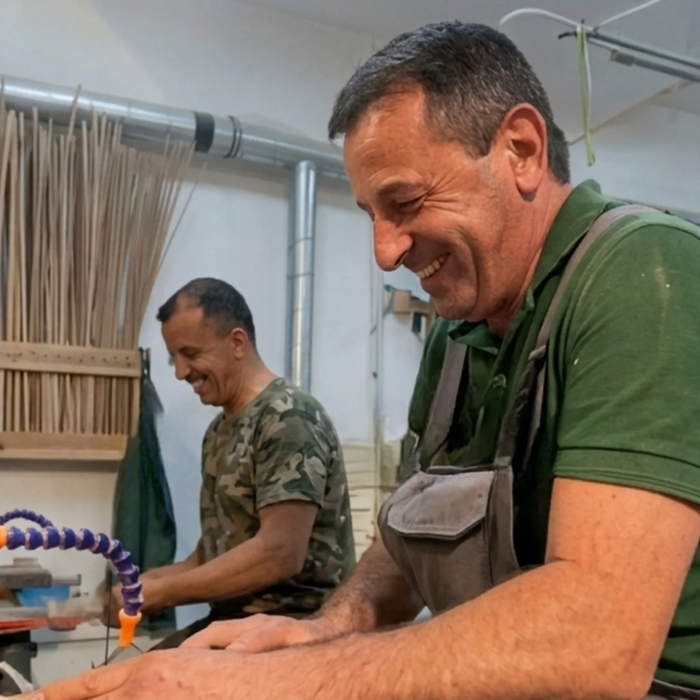
Made by Uwe Deckelmann and his daughter Hanna. Bauspiel sets are manufactured across Europe, in Bosnia and Herzegovina, Austria, and Germany. The finishing, the quality control, and the shipping are handled in Augsburg, Germany. Faceted gems set into pale European hardwood. 70 Bauspiel pieces in my shop, with a 4.9-star average across 71 reviews.
The first thing that happens when a Bauspiel shipment arrives is that someone picks a piece up. I set the cylinders on our windowsill the day the first order came in, and within ten minutes my girls and half the grown-ups had wandered over and reached for one. I have learned since to keep them back from the edge, because people cannot help themselves, and whatever is sitting beside them tends to go over.
Each cylinder is solid acrylic, faceted all the way around so it catches light from any angle. On a shelf it says nothing. Set it on a windowsill in the afternoon and it throws color across the wall. On a light table it glows from below. That is the whole trick, and it works every time.
I have carried Bauspiel since 2021, and I was among the first US shops to do it. The longer it has sat on my shelf, the more I have wanted to set it where it belongs, inside a long tradition of German toymaking. That tradition has a beginning, and it starts in a classroom.
The tradition, briefly
Bauspiel means building game. Bau is to build, Spiel is play. It is an ordinary German word, the kind any teacher would use, and the idea behind it is old. In 1837 a teacher named Friedrich Fröbel opened the first kindergarten and put a set of simple wooden forms at the center of it: a sphere, a cube, a cylinder, then small blocks a child could take apart and build again. He called them the gifts. Maria Montessori and Rudolf Steiner both built on what he started. The idea is that a child learns most from the plainest object, the one that asks nothing and allows everything. Bauspiel keeps that whole idea, and changes one thing about it.
The maker
Uwe Deckelmann spent three decades supplying wooden toys to German kindergartens before Bauspiel existed. Starting in 1983 he sourced from other workshops, drove the routes, and listened to what the teachers told him: which shapes held a child's attention, which ones got quietly put away. The ideas were piling up all the same. When he finally launched Bauspiel in 2013, three decades of watching went into it, and the Color Track was one of the first things he made. He has designed with his family from the start, and his daughter, Hanna, now runs the business with him.


Hanna and Uwe.
The one place it breaks from tradition
For almost two centuries the rule of open-ended play was the bare block, kept plain so the child could supply everything. Bauspiel keeps the plain block and adds one thing to it: a faceted gem set into the wood, so the block throws color and light. That is the whole departure, and the company has built its line around it.
Uwe will tell you exactly why he did it. In the German kindergartens he supplied for decades, he noticed the block corner pulled in the boys, with their towers and their structures, more than the girls. So he set what he calls diamonds into the blocks. "To get the girls in the construction zone, we started to put some diamonds in," he said in a 2021 interview. "It works." What he describes since is both at the blocks together: girls moving into architecture and structure, boys into design and the story, each pulling the other along. He set out, in his own words, to bridge the work of building something big with the impulse to make it beautiful.
Where it is made, plainly
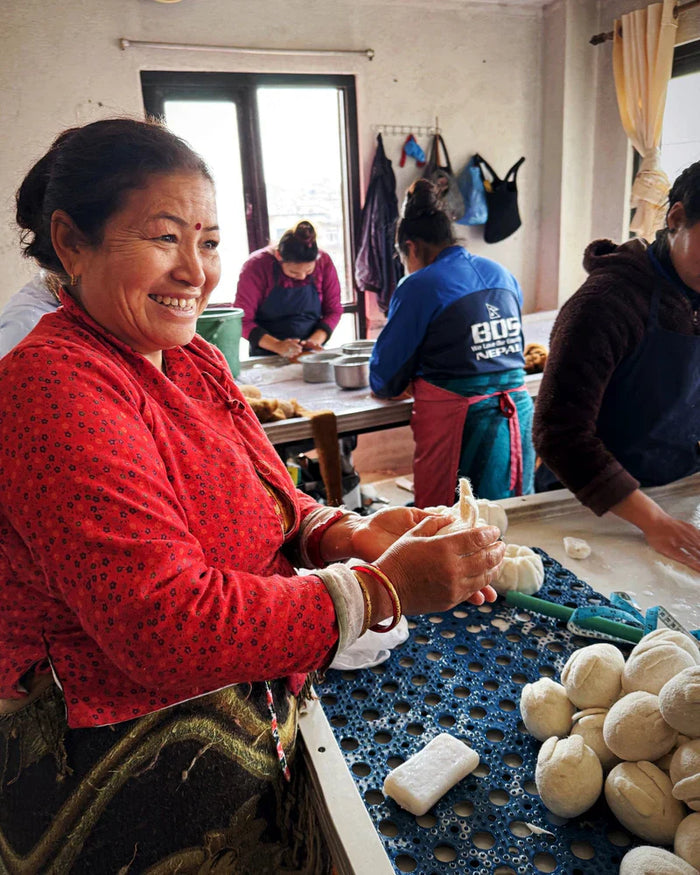
Bauspiel sets are manufactured across Europe, in Bosnia and Herzegovina, Austria, and Germany. The finishing, the quality control, and the shipping are handled in Augsburg, in Bavaria, at a site that runs on hydroelectric and solar power, packs in recycled materials, and keeps spare parts for every piece it makes.
The wood, and the light
The wood is mostly alder, with some beech and lime, all European. Alder is pale and smooth, with almost no grain to compete with the color of the stones. The pieces are left unvarnished. The grain varies, some pieces carry knots, and Bauspiel calls these birthmarks and leaves them where they fall. No two pieces are quite the same, and that is the maker's hand left in.
The stones are cut with facets all over, so the light bends and scatters as it hits them rather than passing straight through. Set a piece on a windowsill in the afternoon, on a light table, or on a white sheet of paper on the floor, and it stops being a block. It becomes a small lens, and the color it throws moves as the light does.

Gem blocks and lucent cubes catching the light. Photo courtesy of Bauspiel.
The Color Track
Bauspiel released the Color Track in 2013, the year the company launched, and it is still the set most families start with, and the one that explains the rest. Forty large blocks in graduated color, each carrying two faceted gems, plus a few plain wood blocks and a heavy wooden crate that is part of the play. Each block is 10 by 5 by 2.5 centimeters, and that is the quiet engineering of the whole line: two laid side by side, or two stacked, line up exactly with a Lucent Cube. Every set Bauspiel has made fits every other one. A block bought today still belongs with a block bought three years from now, and nothing goes obsolete. Uwe chose those dimensions partly so the pieces would combine with other makers' blocks as well, which is how children actually play, mixing brands without a second thought.
The Color Track is one of the few toys I carry that holds a two-year-old and a seven-year-old at the same time, for completely different reasons. The younger one stacks the bricks (or blocks) and holds them up to the light. The older one builds the structure first, then works out where the light should fall.
The X-Blocks and the Fairytale pieces
The X-Blocks are the architectural piece: long alder planks with an X-shaped channel down the center that locks into walls and towers and holds a Lucent Cube in its mouth, so the wall itself glows. The Fairytale pieces pull a different kind of play, broader and more story-driven: chunky arches, towers, and gates, each with a gem set into a window or a doorway. A child who builds straight towers with the X-Blocks will do something else entirely once you set a handful of castle pieces down. Both are building. Bauspiel made them to work together, so the tower and the castle end up in the same scene.

What I have watched it do
The same thing comes back to me, at home, and in the pictures customers post. My girls sit down with a handful of pieces and stay there. Twenty to forty minutes of building is normal, which is a long time for young children and a long time for almost anything else on my shelves. There is no finished picture on the box. A Color Track becomes a road, then a tower, then a window. A wall of cubes becomes a castle, then a fence, then a thing only the builder can name. The pieces ask nothing. The child supplies everything.
"Everyone is drawn to these. They are fun to stack in a window and watch the light come through, use as loose parts, and make patterns out of. Littler kids love to plop them in the holes of the grids, and it is fun for everyone to make a wall of X-Blocks and fill all the holes with cubes to watch them sparkle."
Mary M., verified purchase
What I carry, in stock now
A family usually starts with one piece and adds to it over the years, because nothing in the line goes obsolete. The color sequence is the same across every set, so a piece bought today works with one bought later. These are the ones that go fastest and come back as repeat orders.


Browse the full Bauspiel collection
Caring for Bauspiel pieces
The wood is left unvarnished, and that is on purpose. Wipe the pieces with a dry cloth, and keep them out of standing moisture, since the wood will dull if it sits wet. The gems are set flush and need nothing. And because Bauspiel keeps spare parts for everything it makes, a lost or damaged piece usually means a replacement rather than a retired set. Email me and I will help you get one.
What families say
Bauspiel holds a 4.9-star average across 71 reviews in my shop. A few, in my customers' own words:
"This was our first Bauspiel purchase and my child and I have had a lot of fun with it. The quality is terrific, and I really appreciate how this can be used to teach fractions. I highly recommend this, especially to homeschoolers who want to use these as math manipulatives as well as for building and play." -- Pamela L.
"These color tiles look simple but are deceptive. They can be used in so many ways: as parts of landscapes, as roofs for structures, as floors and levels in buildings, for a kind of wooden house of cards, for color matching. The colors are very vibrant. No regrets." -- Jennifer F.
"They make builds go up so fast. They are great with the lucent cubes for fine motor practice, and they smell so good." -- Valerie S.
"My Toy Wagon did a great job packaging with care, and I'm so happy it arrived in time for my little one's birthday. She took to them immediately, and likes putting the cubes inside the X's." -- Jennifer J.
Reviews from Judge.me. 71 Bauspiel reviews, 4.9-star average as of June 2026.
Families write to me about Bauspiel years later, long after the box was first opened, and what they tell me is always the same: it is still out. At our house the cylinders went back to the windowsill. The cubes are still on the light table. The X-Blocks stayed because someone always wants to fill one more hole. That is what I was looking for when I carried the first set in, and it is what I look for in everything on the shelf.
Questions I get asked about Bauspiel
Where is Bauspiel made?
The sets are made across Europe, in Bosnia and Herzegovina, Austria, and Germany. Every set is then finished and quality-checked in Augsburg, Germany, at a workshop that runs on hydroelectric and solar power and keeps spare parts for every piece it makes.
Who makes Bauspiel?
Uwe Deckelmann, who supplied wooden toys to German kindergartens for thirty years before founding the company in 2013. His daughter, Hanna, runs the business with him.
Why does Bauspiel set gems into the blocks?
To bring more children into building. In the German kindergartens Uwe Deckelmann supplied, the block corner drew the boys more than the girls, so he set faceted gems into the blocks to invite the girls in. In his words, "to get the girls in the construction zone, we started to put some diamonds in. It works." What he has seen since is boys and girls building together, girls moving into structure and architecture, boys into design and story, each learning from the other.
Is Bauspiel connected to the Bauhaus?
No, and the confusion is understandable. In 1923 the Bauhaus student Alma Siedhoff-Buscher designed a famous wooden building set sometimes called a Bauspiel, since the word simply means building game in German. Bauspiel the workshop, founded by Uwe Deckelmann, shares that common noun but has no connection to the Bauhaus school or to Siedhoff-Buscher's set. What they share is the older German idea that children learn best from simple, open-ended materials, not a design lineage.
What wood does Bauspiel use?
Mostly alder, with beech and lime, all European hardwoods. Alder is pale and smooth, with a tight, even grain that does not compete with the stones. The pieces are left unvarnished.
Are Bauspiel pieces safe, and what age are they for?
All Bauspiel pieces meet EN 71, the European toy safety standard, and are CPSIA compliant for the US market. The acrylic stones are set flush in the wood, not loose. Most sets are suitable from age 3 and up; check the individual product listing for age guidance on any set with small pieces.
How do the pieces work together?
They are designed to be compatible across the full line. Lucent Cubes sit in the holes of the grids and drop into the X-Blocks, which stack and interlock. The color sequence is consistent across every set, so families typically start with one piece and add to it over time. Nothing becomes obsolete.
Do you offer Bauspiel for classrooms or educators?
Yes. I supply Bauspiel to early childhood classrooms and can put together bundles sized for your rooms. Teachers who use it report building sessions of twenty to forty minutes, longer than almost anything else in the room. Sign up through the educator program to get started.
Where can I buy Bauspiel in the US?
At My Toy Wagon. I ship from California. Email me at contact@mytoywagon.com if you need help finding a specific set.