Handmade in Bran, Romania by a husband-and-wife workshop. Maple, hand-painted, and built to hand down. 415 Bumbu pieces in our shop, one of the largest Bumbu selections in the US, with a 4.9-star average across 380 reviews.

A new Bumbu shipment landed on our packing table this week, and we did what we always do before anything goes on a shelf. We opened a box, took a piece out, and turned it over in our hands. This time it was a little gray squirrel mid-run, no bigger than a child's thumb, with the faintest tool marks still readable under the paint. You can feel where a person held it.
We were among the first US retailers to carry them. Most families who find us were looking for Bumbu specifically and couldn't find it elsewhere. Here is how the pieces are made, and why they cost what they cost.
The makers
Bumbu Toys is the work of Vitalie and Marina Bumbu, a husband and wife who started the shop in 2018 in Bran, a mountain town in the Transylvania region of Romania. They are a family with two children, and their workshop sits about 1,000 meters up, close enough to Bran Castle that the tour buses pass it on the way. The split has held since the very beginning: Vitalie does the woodwork, Marina paints.


What started with the two of them has grown into a whole crew, but the work is still done the slow way, by hand.
Watch how a Bumbu animal gets made
It goes roughly like this. Each shape is drawn onto the wood by hand and cut out on a band saw. The rough cut is carved and sanded until the edges soften into that rounded, hold-it-all-day shape. Then Marina and the team paint each figure by hand with non-toxic, water-based paints. Because it is done by hand, the gray on one raccoon is never quite the gray on the next.


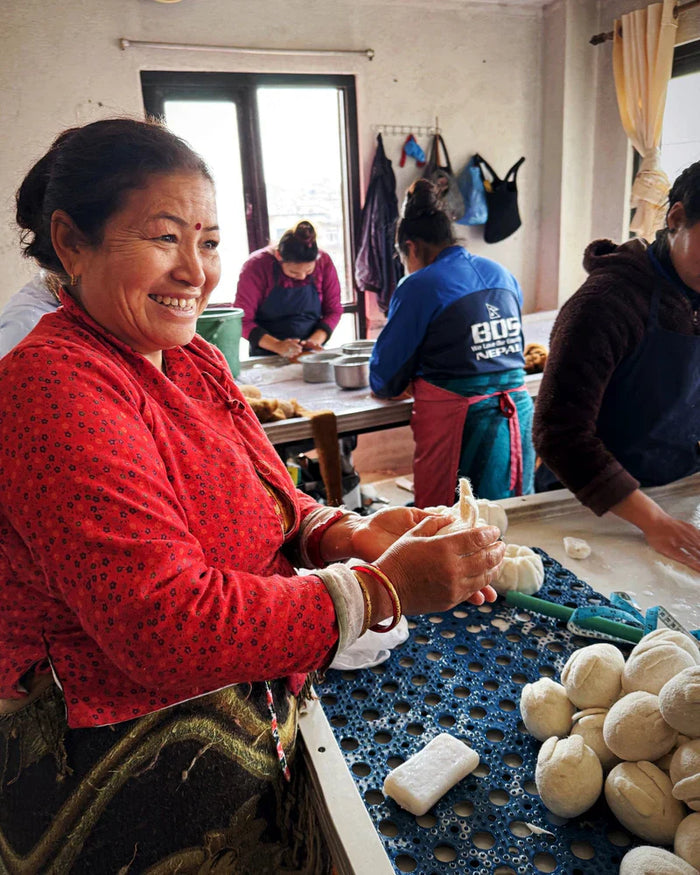
Left: the workshop crew in Bran. Right: Marina painting. Colors mixed in the workshop.
Last comes the finish: a natural oil and beeswax seal that gives the wood a low, warm sheen and protects the color. That hand-finishing is the whole reason a Bumbu fox looks like a character and not a product.

“Bumbu just NAILS the ability to wrap whimsy, beauty, personality, and emotion into these adorably well made wooden figures. Love having a set with the adults + cubs and a mixture of postures, which add more options into story time and open ended play.”
-- Megan S., Bend, Oregon. Verified buyer.
The wood and the finish, plainly
Bumbu carves primarily from maple. Some pieces use other northern hardwoods where the shape calls for it, but maple is the backbone of the line, and all of it is sustainably sourced. The paints are non-toxic and water-based, and they meet the EN 71 Safety Standard, the European standard for toy safety. Each piece is then sealed with a natural oil-and-beeswax finish rather than a thick lacquer, which is what gives the wood its soft, matte feel.
A note we want to be straight about: these are made for ages 3 and up. Every Bumbu piece is marked 3+, not suitable for children under 36 months, because the smaller figures and set pieces are a choking hazard for babies. They are wonderful open-ended toys for preschoolers and up, not teething toys.
The summer series
These are the pieces we reach for when someone is building a first collection. The scale holds across the whole line, so forest pieces, pond pieces, and ocean pieces all layer together naturally. All in stock now, shipping from our Arcadia, California location.


Caring for Bumbu toys
- Dust with a soft dry cloth for day-to-day cleaning.
- For a stubborn spot, use a barely damp cloth with a tiny bit of mild soap, then dry right away. Never soak them: the wood absorbs water and can warp.
- Store somewhere cool and dry.
- Every so often, revive the finish with a small amount of non-toxic natural oil buffed in and excess wiped off. Avoid heavy washing, which fades the paint.
What families say
Bumbu pieces hold a 4.9-star average across 380 reviews in our shop. A few, in our customers' own words:
“At first it was just the cheese. My son loves cheese. Then when he discovered it fit into the raven's mouth, it became next level. Currently his favorite duo.” -- Amber T., Poughkeepsie, New York
“My granddaughter recently had the waterfall pouring out of the doll's house kitchen sink. She simply stated 'plumbing problems.'” -- Carol C., Maryland
“The quality and attention to detail of Bumbu birds is unheard of. They have a customer for life with me. We have a heron that visits the pond at our local park and I'm happy to give this little replica to my daughter.” -- Kylie G., New York
“Not dipped in paint that eventually chips. The paint here is strategically placed letting the rest of the wood shape breathe.” -- Mary M., Wisconsin
“The painted details are perfectly applied. The ottery essence is captured with charming simplicity.” -- Melissa S., Virginia
Reviews from Judge.me. 380 Bumbu reviews, 4.9-star average as of June 2026.
We started carrying Bumbu when very few US shops had heard of them. We still carry 415 pieces, one of the largest selections in the US. Families who bought a fox from us two years ago write back for the ocean series. That is what we were looking for when we found them.
Questions we hear most about Bumbu
Where are Bumbu Toys made?
In Bran, Romania, in the Transylvanian mountains. A stone's throw from Bran Castle, the 14th-century fortress built in 1377 to defend borders and control trade, and known worldwide as "Dracula's Castle" for its cliff-side silhouette. The Bumbu family's workshop sits in the same valley. The tour buses pass it on the way up.
Who makes Bumbu Toys?
Vitalie and Marina Bumbu, a husband-and-wife team, with a small workshop crew. They founded the brand in 2018.
What are Bumbu Toys made of?
Primarily maple, with other sustainably sourced northern hardwoods for some pieces. Hand-painted with non-toxic, water-based paints that meet the EN 71 Safety Standard, and sealed with a natural oil-and-beeswax finish.
What age are Bumbu Toys for?
Ages 3 and up. Not suitable for children under 36 months due to small parts.
How do you care for Bumbu Toys?
Dust with a soft dry cloth. For a stubborn spot, use a barely damp cloth with a tiny bit of mild soap, then dry it right away. Never soak them. Store somewhere cool and dry. Every so often revive the finish with a little natural oil. Avoid heavy washing, which fades the paint.
Does My Toy Wagon ship Bumbu Toys across the US?
Yes. We ship from Arcadia, California. Free shipping on orders over $150 to the lower 48 states. See our shipping page for details.